
SMAC Moving Coil Actuators Triple Forces But Prices Remain the Same
Small actuators for higher force applications.
SMAC Moving Coil Actuators, a leader in 21st century mechatronics, announced the new LCB model will be released in early 2016. The LCB more than doubles force in same package size, enabling SMAC to continue its strategy to reduce prices by 35% every 5 years compared to the previous SMAC series, a practice the actuator manufacturer has been following since 1995.
Force more than doubles with the LCB over comparable LCA actuators due to a much higher "Flux Density" (>10K Gauss) in the Moving Coil Actuator magnetic circuit. For example, the 25mm x 40mm sized LCB 25 can produce up to 80N vs 25N in the similar sized LCA 25. Further, accelerations with the new LCB now exceed 100G. This makes SMAC a competitive solution for some higher force applications, previously dominated by pneumatic actuators.
The technology used in the LCB Moving Coil Actuator transfers from SMAC's advanced direct drive robotic finger project, recently presented at the International Robotics Show in Tokyo, Japan. The SMAC robotic finger was introduced earlier this year in Chicago, Illinois, and Hannover, Germany. The 25mm motor used in the front joint (PIP) is a servo "partial" motor and equipped with an SMAC rotary encoder with 15.5K counts per revolution. It achieves a high torque/diameter ratio due to the proprietary magnetic circuit design as well as the coil design. Intellectual property rights have been addressed.
Featured Product
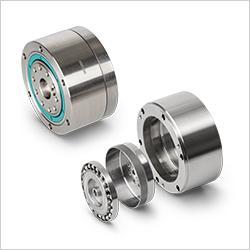
Strain Wave Gearheads by maxon - Highly precise, compact, and efficient.
Strain wave gearheads are ideal for use in applications requiring precision motion control and high torque transmission in a compact design. maxon strain wave gearheads are a specialized type of gearhead where precision and compact design are crucial. This type of gearhead is often used in applications in a confined space. With their advanced gear tooth design, maxon's strain wave gearheads provide high efficiency and good back drivability. Typical applications include: Robotics, Aerospace, Medical technology and Optical systems .